My post today is going to be a little different. It is a short story I wrote a number of years ago, after meeting recent migrants. This story is not meant to hurt, harm anyone or have any unwanted connotations. This story depicts some of the issues faced by migrants trying their utmost to assimilate into a new culture.
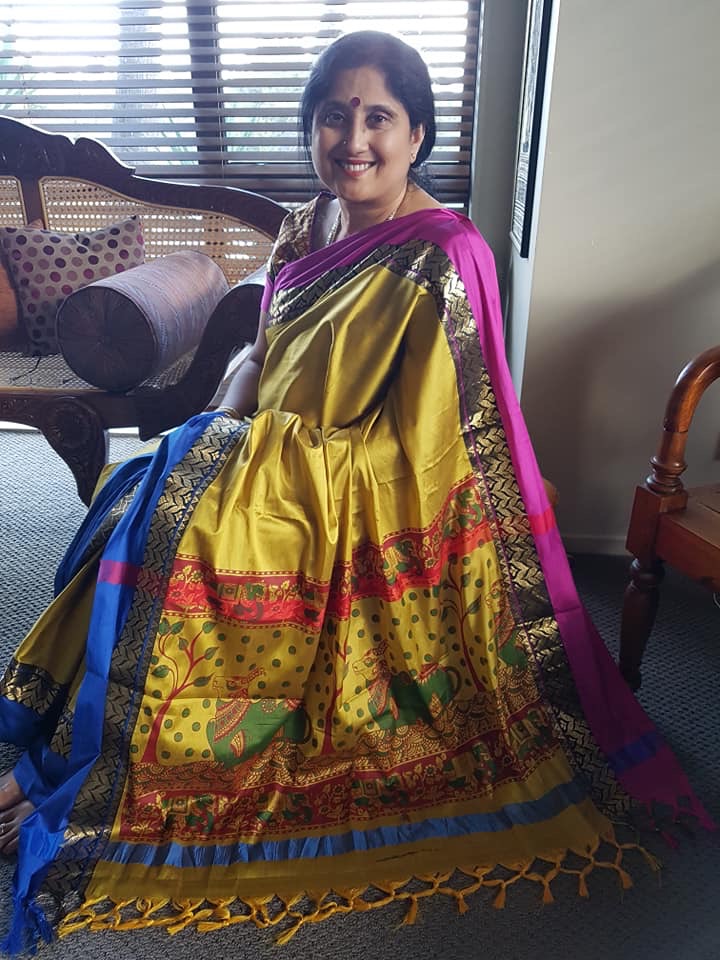
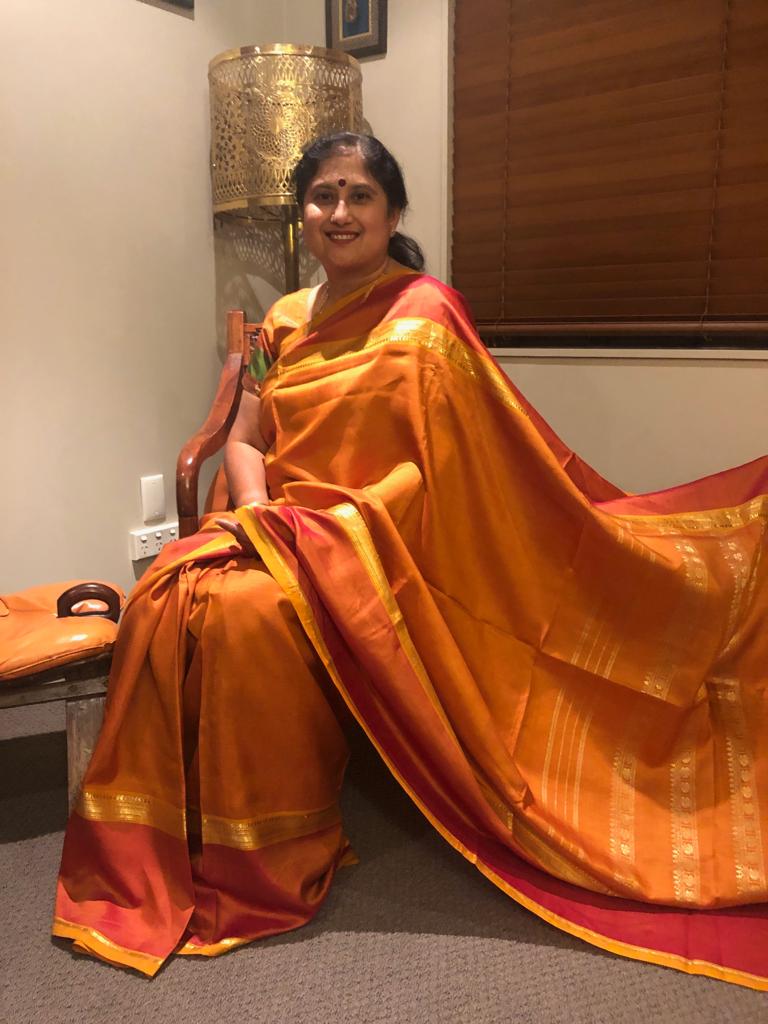
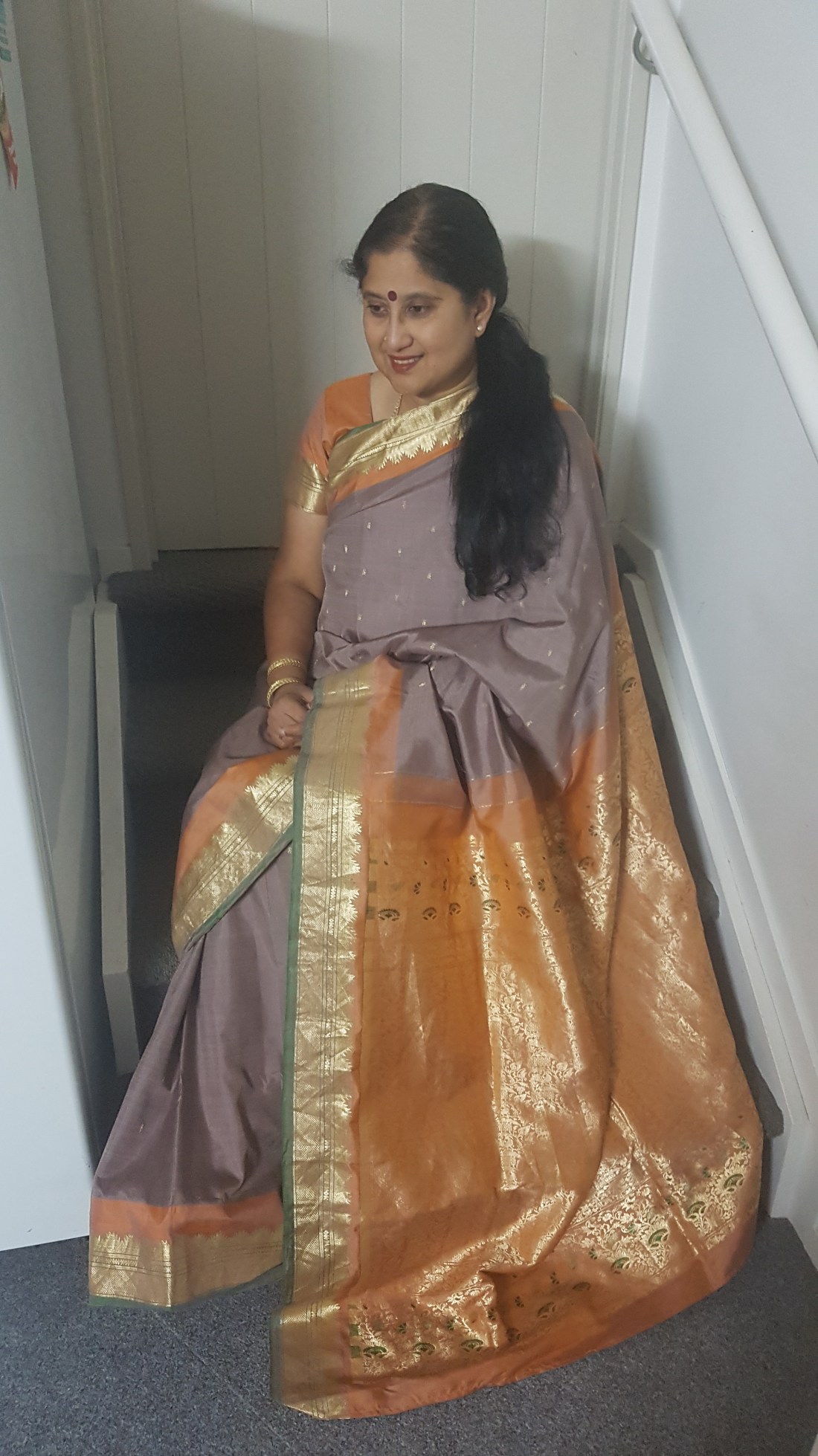
Here I am sitting on my garage stairs, trying to pose coyly? trying to act naturally uninterested, if there is such a meditative state of being. Am in an ambiguous shade of beige-brown-ash with an orange and gold pallu and orange, green, gold borders.
THE PERFECT JOB
This is a simple story. Somewhat like the fairy tales written by the Grimm Brothers. I say ‘somewhat’ because it is a grim story, that being the only likeness it shares with the Grimm Brothers. This is my story, your story, our story, the story of hope at the beginning, disappointment and despair in the middle, and hope and a certain kind of happiness at the end. The story of women the world over, migrants, residents, citizens. Now, read on.
Mrs Devarajah was excited. The ‘East Tamaki Courier’ had so many opportunities lined out for her. ‘Widening my horizons’, she’d proudly told her husband over breakfast six months ago. Mr. Devarajah had nodded and said ‘Anything goes, chellam. I’ve told you you don’t have to work but if it makes you happy, go for it’.
Mr and Mrs Devarajah had arrived in New Zealand about seven years ago with their eleven year old son. In two weeks and five days it would be exactly seven years. Mrs Devarajah had been the head of gynaecology at St Peters’ Hospital in Sri Lanka. Mr Devarajah’s profession had been on the ‘Critical Migrant Job List’, being an IT consultant. At the airport, upon disembarking from the flight, Mrs Devarajah, being highly religious, had touched the ground and then touched her forehead. She had remarked ‘A Land of Milk and Honey! We will truly be happy here’. That was seven years ago.
Now, things were different. Initially, Mrs Devarajah had been quite content to be at home and not have to work. ‘Being a good mother and wife and homemaker’, she’d remarked to anyone who’d care to listen. She’d loved planning breakfast, lunch, dinner and snacks, whipping up meals for friends who dropped in from time to time. In Sri Lanka, she’d had a maid, a cook, a nanny, chauffeur and gardener. Here, Mr and Mrs Devarajah jointly functioned as all of them. Mrs Devarajah loved ‘being on top of everything’, as she so aptly put it. She knew exactly how clean the bathroom rugs were, how white the shower stalls were, whether the hair near her dressing table had been picked up. But now, she was not so sure anymore. She found lately that she was always irritated. She also felt that Mr Devarajah and now 18 year old Ashwin didn’t need her anymore. The initial excitement of doing things together had faded. They were all wrapped up in their own secure and insecure worlds. Her friends seemed to look down on her. And there was this nagging feeling at the back of her mind that maybe she was developing Alzheimer’s – she could never remember anything unless she wrote it down on the whiteboard taped to her fridge door or her black worn dog-eared diary. Whenever she mentioned her memory lapses to her husband, he would laugh it off saying she was not using her mind and that she should either go back to studying, doing ‘one of those short courses’, or get herself a job.
So, that was what she decided to do. Every morning, once she’d cleared the breakfast table, emptied the dishwasher, hung the laundry out to dry, she’d settle herself in front of the computer. She’d browse the various job search web-sites, then proceed to draft, proofread and email various application letters and her curriculum vitae, which she would then carefully upgrade or downgrade according to the position for which she was applying.
At first, her hopes were high. She applied for managerial, clinical and surgical positions on various health boards and hospitals. But after one more of a long succession of rejection letters and emails, always beginning with ‘We regret to inform you that..’ and closing with ‘We will keep your records on file..’, she was forced to lower her expectations.
Sometimes, however, she got to the interview stage. Armed with her CV and photocopies of her degrees, she would mentally recite every conceivable mantra she knew whilst walking into the room. She would look her interviewers straight in the eye, offer a firm handshake and proceed to answer all questions in a way she believed would floor them. She always left the room on a high, feeling she had clinched that perfect job. But a letter or a call a day or two later would leave her in an all-time low.
On one such day, she sat in her little blue Toyota Starlet at the parking bays of her friendly local supermarket. She had just come out of a particularly stressful ordeal at a local surgery. The interviewer this time did not smile and kept interrupting her in mid-sentence. Worse still, he looked extremely bored and could not help stifling yawns. At one point, she pushed her chair back heavily, got up and told him where he could stuff his job. She told him that no matter what he or anyone did, she knew she was the perfect one for this job. She had her degrees, credentials and more experience than any of them put together. With that she strutted out, head held high, feeling curiously satisfied as she slammed the door behind her.
So here she was, sad not-so-young and now not-so-optimistic Mrs Devarajah, trying very hard not to cry. She knew she had to get some groceries but she couldn’t remember what they were. Then, with a resolve, she turned off the engine and got out of her car. ‘What the heck! I’ll walk along the aisles and pick up what I want! I’ll cook what I want today! Or maybe I won’t cook! Let them cook, let them order a takeaway or better still, let them starve!’ And with that thought, she strode through the automatic entrance doors.
She stared at the rows of fruits and vegetables, her eyes unseeing. She continued walking on aimlessly. She had no choice. These supermarkets were designed to ensure that customers started at the entrance and worked their way through the entire shop till the exit. She threw tins of chopped tomato into her cart. She picked up some milk and cheese from the cold room. And all the while her mind played on the unfairness of her situation. She glanced around her and saw women, young, old and middle-aged like herself, some with babies and toddlers seated atop shopping trolleys, their plump legs kicking, others with a pre-school child lagging behind them, whilst their mums searched for items and scrutinized labels. All like her, or were they? They looked happier, she thought. Maybe they had part-time jobs, maybe they didn’t have to cook so much or clean so much. Maybe their husbands shared household chores. Maybe they had part-time house help. Or maybe they had perfected the art of stress-free house cleaning.
Without realising, she’d reached the checkout counter. She smiled at the teller lady. She knew Gloria. On one of Gloria’s bad days, when a customer had insisted that she’d keyed in the wrong bar code, hence charging him an incorrect price, and said customer had further insulted her by saying that she needed to take a language and IT course, Gloria had unburdened everything onto Mrs Devarajah, as she’d had the honour of being the next customer in the queue. Gloria was from the Philippines and had in her hey-day, held a position of great authority at the Ministry of Education. Mrs. Devarajah had managed to nod sympathetically, at that time feeling a little embarrassed that she’d obtained the coveted position of being counsellor to an irate teller. Gloria continued, unrelenting, about one Mr Chatterjee, a Bengali ‘rocket scientist’, a term espoused by Gloria in reverent hushed tones. Gloria’d told her that his qualifications hadn’t been recognized, he’d refused to sit for an examination and so he was now driving a taxi. ‘Nothing wrong about that’, Gloria had emphasised, ‘But you know for us Asians, we have this thing about white and blue collar work’.
‘That will be fifty-six dollars and seventy cents.’
Gloria’s voice jolted Mrs Devarajah back to the present. She rummaged in her diligently-rearranged-once-a-week handbag for her purse, always elusive under the wad of notes, tissues and bills. She paid, then burst out, knowing that if she didn’t speak out now she should have to hold her peace forever.
‘Take me to your manager, Gloria. I need a job.’
Gloria eyed her suspiciously. She slowly nodded, understanding. Mrs Devarajah too had reached that stage. Mrs Devarajah had landed with a rude thud flat on her feet. Her feet would be sore but she’d survive. They all would, eventually. They all did. They all arrived, well-qualified, bright-eyed and bushy-tailed, then blow after disappointing blow would ensure that they compromised and saw the stark reality of their situation. It was the nature of things. That was how it was supposed to be.
Gloria paged for her supervisor who arrived unsmiling at having been disturbed from her difficult labour-intensive task of watching her inferiors. Mrs Devarajah noted the hierarchy even here in a supermarket – a complex caste system. One could not escape from these classes, subclasses, sub-sub-classes, one migrated from one’s motherland to escape the clutches of this but it was there everywhere. In a supermarket, in the 123 dollar store, at the beach, at a restaurant, at a petrol station. Wherever there was money being earned, wherever there were superiors and inferiors, supervisors and worker ants, the system was in place, unclenching its fists, stretching its gnarled fingers and curling around one and all.
Mrs Devarajah pushed away the myriad thoughts that played at the back of her mind. She had to answer all questions. Correctly. Relative to the manager’s expectations. Correctly.
She was at the manager’s door. She knocked, entered, pulled up a chair to sit without being asked to. She’d forgotten her rehearsed speech. Instead, she informed the manager – she needed this job. No, she could not get anything else. Yes she would work hard. Yes she was good with her hands – after all she had delivered babies, performed micro-surgery, but it did not matter now, no one needed to know all that – they’d deem her ‘over-qualified’, a well-worn term. No one wanted to know all that anyway. Yes, she was alert, with a keen eye for math, was a quick learner. Yes she could and would work well with people. Yes, she loved meeting new people. No she did not get flustered or angry easily. Endless questioning. She answered them all. Correctly.
And all the while, parallel thoughts plagued her. What would her politically correct friends think? Her doctor, engineer, lawyer, accountant friends, their husbands, their families? What would Mr Devarajah say? The so-called drop from white collar to blue collar worker. How could she change the mentality of the typical upper middle class Asian? But she consoled herself – she was no longer in Asia. Her hands were tied, if she continued on her current path of self-destruction, trying to keep up with the Jones, she would go insane. Here at last, here at least, there was some distraction from the mindless routine she waded through daily. It was not the money. It was the company that mattered, the feeling of belonging, the feeling of being worthwhile. And bringing home something which she had earned – a feeling she hadn’t realised she’d been missing for so long, a good feeling after seven years of taking handouts from Mr Devarajah, not that he’d minded, she had to give him that much credit, God bless his good soul.
She walked out of the supermarket. She’d forgotten her groceries, but it did not matter. She unlocked her car, and from the front seat, removed her file, replete with CV, photocopies and letters of recommendation. Without hesitating, she dropped it into the garbage bin, located an arm’s throw from her car. That too was meant to be. The garbage bin, she meant. In the correct location, waiting to swallow her dreams.
Mrs Devarajah spied a single orange calendula poking its head out of the well-manicured beds segmenting the parking areas. It was then that she understood everything was going to be just fine, or in Maori, just kapai.
And so readers, that was how, one afternoon, in early spring, Mrs Devarajah managed to land The Perfect Job, thus ensuring that this is indeed a fairy-tale ending to a good story.








 Bavani’s Happy Place